

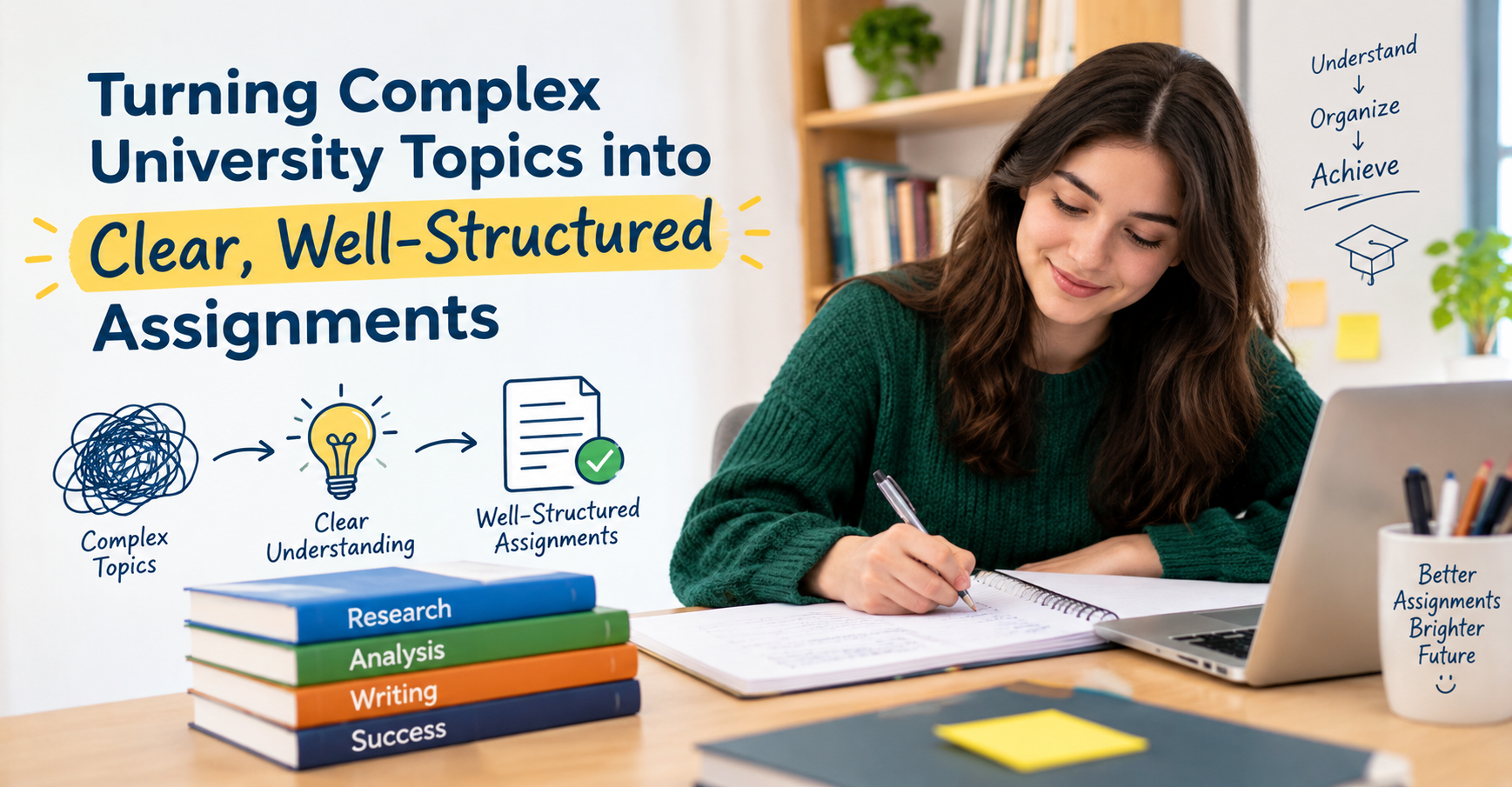
Picture a second-year student opens their assignment and reads the topic. They find it too difficult to understand at the moment so they close and tell themselves they’ll look into it later. That later often comes the night of submission and all that procrastination turns into panic to do the assignment in a rush.
Sounds relatable? If you have also found yourself typing online assignment help into Google, then you are not alone. This is what most of us would do when a topic feels like a heap of loose bricks. Nobody had ever told us that turning a messy topic into a clear assignment is a method and not a talent, and that methods can be learned like anything else. In this blog learn about turning overwhelming topics to a simpler explanation of what you need to do in the assignment.
Why Complex Topics Feel So Messy
University topics are rarely one idea. They’re usually several ideas tangled together, with a couple of arguments between experts and a lot of specialist words on top. Read in the order the reading list gives you. Those ideas turn into notes shaped like the checklist list, and than an essay shaped from those notes, so the marker ends up on a guided tour of the topic when they were hoping for an argument. Reading more won’t change that. Deciding what you want to say will.
Start With a Smaller Question
Plenty of frightening assignments turn out to be three small questions in a trench coat. Read the question twice, underline the instruction word, whether it’s compare, evaluate, or critically discuss, since each one wants something different, and then rewrite the whole thing in your own words with a quick list of what you’d need to know to answer it. Whatever doesn’t help can wait for another day. A lot of good online assignment help begins right here, with somebody asking what the question is actually after, because a beautifully written answer to the wrong question still loses marks.
Draw the Skeleton Before the Sentences
Before you write a proper sentence, write one line for each section. The introduction says what you’ll argue, each body section makes a single claim, and the conclusion says what follows from all of it. If a section seems to need two claims, split it. If you can’t state the claim in a line, you probably haven’t finished thinking about it, and no amount of nice phrasing will hide that. A sketch like this turns a vague mountain into four or five smaller jobs, which is why a lot of online assignment help sessions spend longer on the outline than on the writing.
The Friend Test
Try explaining your main point to a friend who studies something completely different, in two or three sentences. If they nod, you’ve got it. If they go glassy-eyed, your argument is still wearing its jargon, and your marker will probably feel the same. It’s a trick tutors and online assignment help sessions use all the time. Plain language isn’t simple thinking, and defining a tricky term once in ordinary words, then using it the same way every time, usually shows you understand it better than a page of impressive vocabulary.
Let Your Sources Back You Up
Your own claim has to come first, and the sources are there to back it up, which is easy to forget when you’ve got a pile of quotes in front of you. Stacking five of them in a row and hoping they add up to a point rarely works. It’s usually better to choose a handful of strong ones, say what each of them adds and note where they disagree, something assignment helpers sometimes describe as getting your sources to talk to each other. You should still be audible in every paragraph, even if it’s only in a sentence explaining why a particular source matters.
Where Good Drafts Go Wrong
Most of the damage is done by a few small habits. Writing the introduction first and then rewriting it four times. Fitting three points into one paragraph. Describing a theory at length without ever tying it to the question, or leaving the referencing until ten minutes before the deadline, which is when the mistakes sneak in. When you spot yourself doing any of these, stop and go back to your draft, and if you’re still stuck, ten minutes of assignment help from a tutor can save you from rewriting half the essay at 2 am.
Getting a Second Pair of Eyes
Sometimes you just can’t see the errors in your own work anymore. Maybe you’re writing in your second language, or you’ve been working evenings all week, or the topic simply won’t click no matter how many times you reread the chapter. That’s usually when people look for online assignment help, and it can be worth it if you pick well.
What you want is someone who walks you through how an answer is put together and tells you straight what’s weak in your draft, so you leave with something you can use on the next assignment too. Assignment writing services vary a lot in what they actually do, so read how each one describes its process before you pay for anything.
Walk away from any that promise a grade, or that hint you could hand in work somebody else wrote, since universities treat that as misconduct and it’s your name that ends up on the report. A professional assignment helper that also guides you along instead of just doing it for you is better, and good online assignment help leaves you a bit more capable than it found you.
If You Study in Germany
Students in Germany have a few extra things to juggle, like strict formatting rules, different marking traditions, and the effort of working in a second language. That’s why plenty of people go looking for assignment helpers Germany online, hoping to find someone who understands local expectations.
If you go down that road, ask who would actually read your draft and whether they know your type of paper, whether that’s a Hausarbeit, a seminar paper, or a Bachelor thesis. At our assignment writing agency, we also cater to all such requests, keeping in mind how students here are struggling with the language, meeting academic standards, and juggling jobs and part-time work.
Read It Like A Reviewer
When the draft is done, read it out loud, even if it feels silly. Your ears pick up clumsy sentences and gaps in the logic that your eyes slide straight over. Then go through it paragraph by paragraph and ask three things. Does this one start with its main point? Is there evidence behind every claim? Does the conclusion actually answer the question you were set? Anything